
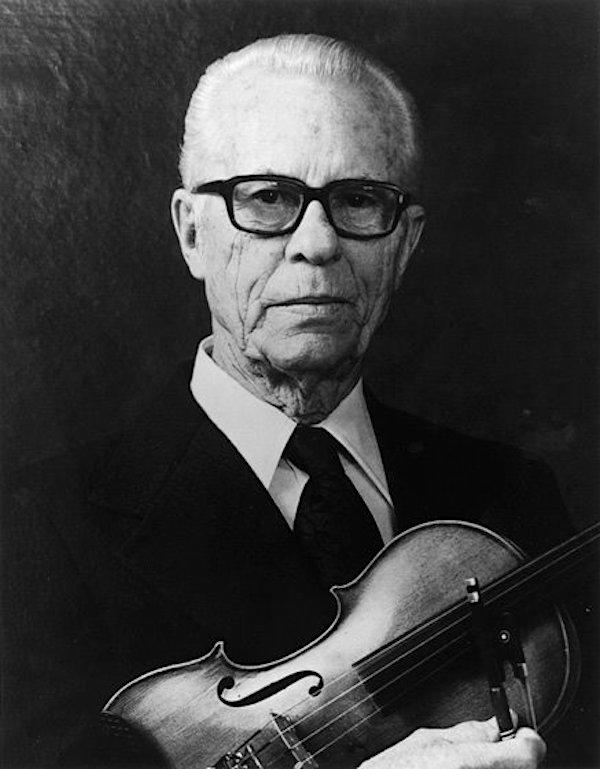
Lyman Enloe was born in Cole County Missouri, in 1906 on the northern edge of the Ozarks, between Jefferson City and Eldon, Missouri. Lyman grew up in a musical family, as his father Elijah (Lige) Enloe became a renowned fiddler who played for square dances throughout the region. Lyman first played rhythm guitar for his brother, uncle and father. By the late 1920’s Lyman was playing on radio station WOS which stood for Watch Our State, from the State Capital Building Dome in Jefferson City, Missouri. At age 18 Lyman took a job in a shoe factory in Jefferson City where he met fiddler Tony Gilmore, and played rhythm guitar for Tony’s band. This was a major shift of musical interest for Lyman, from old time to old time fiddle music. After playing with Tony for a while he was exposed to many other great Missouri fiddlers. At age 22, Lyman’s his father had died and he picked up a fiddle on a joke and dare from his wife, and started learning. Two years later Lyman had a regular date at radio station WOS again. He went to all the jams he could and played fiddle contest that paid $5 to $10 if they were lucky.
Lyman had a playing style that was described as pure, clean and sweet notes with a bowing arm of rolling molasses.
In adulthood, Lyman and his wife had nine children and moved to Kansas City where he worked in the painting and redecorating business, but still fiddled at square dances every chance he could. His unique style of fiddling became well known, even Kenny Baker recognized Lyman as “one of the finest old-time fiddlers I have ever ran into…when I hear him, I don’t have to guess who is playing”.
In 1984, and again in 1985 Lyman was named “Old Time Fiddler of the Year” by the Society for the Preservation of Bluegrass Music in America.
Lyman loved to play the fiddle above everything else going on around him, He was full of nervous energy, and would clear his throat, re-adjust his chair, light a cigarette, sip a gulp of black coffee and be ready to start the jam, When folks around the camper started passing around food and drinks, he would shake his head and say “I don’t know how people can eat when they could be playing music. It was pure joy to watch him play with a glint of fire in his eye and a grin on his face. He played old, old tunes learned from his early years playing with his father and uncle “Pink”.
Lyman played for square dances in the 1930’s, when he could sometimes make $5 for the night, and that the next morning he would be on the porch of the general store when it opened, to buy groceries to put food on the table for the family.
In 1966 Lyman, Jim and other picker friends rented a little school house near Kansas City and started playing every Saturday night. This weekly jam and the addition of more musician friends, like Chuck Stearman on mandolin, eventually led to the formation of a group calling themselves the Bluegrass Association. This band stayed together for 13 years, playing at festivals and show all over the Midwest. A real accomplishment for a band.
Lyman with Jim McGreevy and friends recorded 4 albums, two were primarily vocal bluegrass (which included Lyman’s daughter, Audrey Belt) — and two were fiddle albums. The first was titled “Fiddle Tunes I Recall” and had 23 short tunes, and the second was “Rugged Road”, which had a little more of a bluegrassy flavor. Lyman also took part in a recording in early 1990 called “The Missouri Session”, featuring many musician friends from all over the state. It was well received. He was the oldest participant, at age 84 or 85.
All of the Bluegrass Association members kept their day jobs to support their music habit on the weekends. They even got to play at the Governor’s mansion. Lyman enjoyed jams with Ricky Skaggs (age 15), Kenny Baker, and Byron Berline, and noted a time when him and Byron both failed to qualify for a fiddle contest final round, So they took Ricky and went far into the parking lot and jammed until folks came looking for them. Lyman admits learned a lot from listening to Byron’s albums.
Although he taught some of his children to play the guitar, he was hoping one of his grandchildren would follow in his footsteps and learn to play the fiddle.
Finally his grandson, Dave Belt decided to give it a try. Dave says “he told me the key to making the fiddle sound smooth was in the bow hand action. It had to be fluid and played with a relaxed wrist.” Dave took that to heart and won a few fiddle contests with his grandpa playing rhythm guitar.
He was asked many times to teach others to play, but didn’t much care for that idea. However, one of his neighbors insisted that Lyman teach his 13 year old son to play.
That protégé was Daniel Grotewohl, and he became a bluegrass veteran and Central American Fiddle Champion by age 17. Giving further credence to Lyman’s playing techniques.
After Lyman’s wife passed on, he stopped playing the fiddle. Several years went by and a fiddler named Rusty Dutton started pestering Lyman to teach him the old tunes from his youth. This eventually resurrected his interest in the fiddle and Lyman ended up playing many years with Rusty. Lyman did repair and setup on fiddles, and taught Rusty the craft too.